Quick Summary: The Biomechanics of Cobra Pose and Upward-Facing Dog explains how your spine, shoulders, and muscles move when you lift the chest from the floor. In Cobra, the back muscles do most of the lifting while the hips stay down. Upward-Facing Dog lifts the legs too, so it loads the arms and wrists more. Lift long, not just high, and stop if you feel pain.
Have you ever finished a yoga flow and wondered why your lower back felt pinched instead of open? Two classic backbends look almost the same on the mat. Yet they put very different forces on your bones, joints, and muscles. Studying the Biomechanics of Cobra Pose and Upward-Facing Dog shows how gravity, leverage, and muscle effort work in each pose.
In Cobra Pose, your pelvis stays on the mat and anchors your body. In Upward-Facing Dog, your arms and legs hold your full weight like a bridge. Mix up how the joints work, and your lower spine takes harsh stress. Learn the Biomechanics of Cobra Pose and Upward-Facing Dog below so you can practise safely every day.
How Does Gravity Change the Biomechanics of Cobra Pose and Upward-Facing Dog?
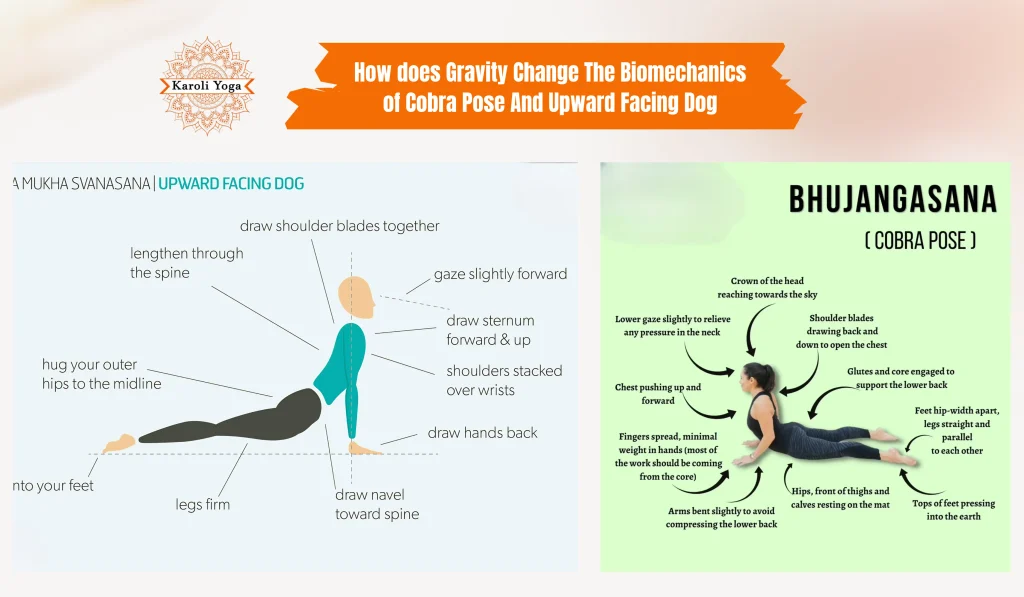
Every pose reacts to gravity based on which body parts touch the floor. Understanding the Biomechanics of Cobra Pose and Upward-Facing Dog starts with two things. First, find your base of support. Second, find your centre of gravity.
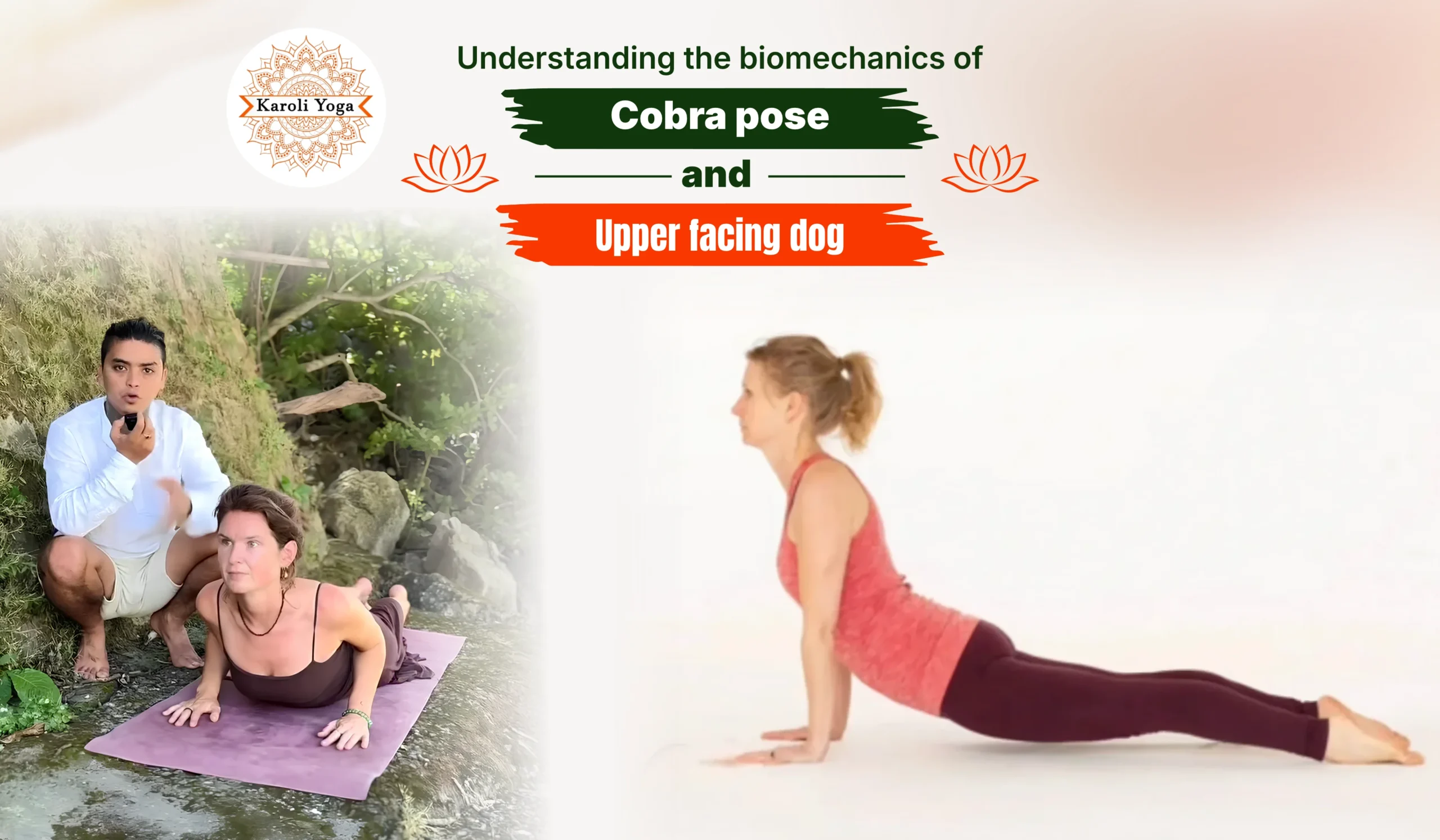
In Cobra Pose (Bhujangasana), your pelvis, thighs, and feet stay pressed into the mat. Your lower body acts like a heavy anchor. Gravity pulls down on your rib cage. Your back muscles must pull against it to lift your chest. This builds strength along the spine.
In Upward-Facing Dog (Urdhva Mukha Svanasana), your hips and legs float off the ground. Only your palms and the tops of your feet touch the floor. Gravity now pulls your hanging pelvis toward the mat. This gives a strong stretch across the front of your body. It also loads your shoulders and wrists.
- Base of Support: Cobra spreads your weight from the pubic bone to the toes. Upward-Facing Dog shrinks the base to four small points.
- Spinal Load Type: Cobra uses muscle effort along the back. Upward-Facing Dog adds a hanging pull through the lower spine.
What Happens to Your Spinal Joints and Vertebrae in Each Pose?
Your spine has twenty-four movable bones stacked in natural curves. The twelve upper-back bones join the ribs. They resist bending backwards. The five lower-back bones have thick discs. They bend backwards very easily.
When you use the Biomechanics of Cobra Pose and Upward-Facing Dog, protect those five lower bones first. If your upper back stays stiff, all the bending lands on one joint, just above your pelvis. That joint then takes too much load.
- Facet Joint Squeeze: Over-arching the lower back pushes small joints together. You feel a sharp pinch near your waist.
- Upper Back Lift: Pull your breastbone forward. This frees the stiff upper spine and shares the bend across twelve bones, not two.
- Pelvic Tilt: Press your pubic bone down. This lengthens the lower back and eases pressure on the discs.
Share the curve evenly, and the Biomechanics of Cobra Pose and Upward-Facing Dog keep your back safe.
How Do Muscle Firing Patterns Differ Between Both Backbends?
Both poses arch the spine. But the muscles that do the work change roles. Knowing the muscle pattern in the Biomechanics of Cobra Pose and Upward-Facing Dog stops fatigue and joint strain.
Back Muscles Lead in Cobra Pose
In Cobra Pose, the long muscles beside your spine tighten to lift your torso against gravity. Your rhomboids and middle trapezius pull the shoulder blades together. This opens your chest. Your triceps work only a little, because your elbows stay bent beside your ribs.
Pushing and Pulling in Upward-Facing Dog
In Upward-Facing Dog, your triceps, front shoulders, and serratus anterior work hard to push the floor away. Your thigh muscles lock the knees straight. Your hip flexors stretch as the pelvis hangs forward.
- Hip Flexor Stretch: Upward-Facing Dog stretches the psoas and the front thigh deeply. This pulls on the front of the pelvis.
How Do Shoulder, Elbow, and Wrist Mechanics Work Together?
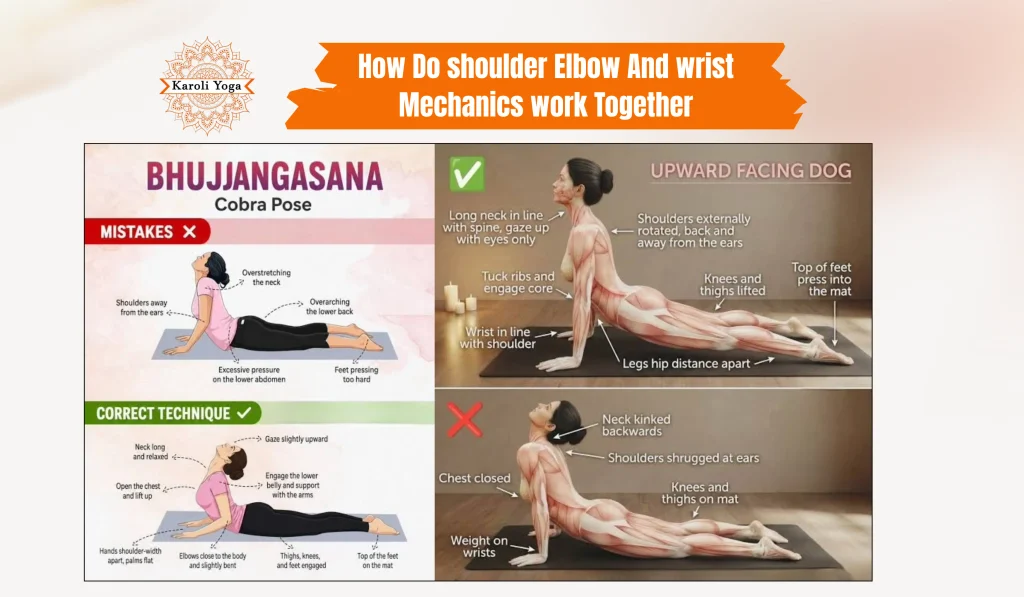
Your arms pass force from the floor into your rib cage. Small changes in joint angle change the Biomechanics of Cobra Pose and Upward-Facing Dog a lot across your arms and shoulders. Use this table as a quick guide.
| Body Factor | Cobra Pose | Upward-Facing Dog | Safety Tip |
| Wrist Angle | Mild bend back (45° to 60°) | Deep bend back (80° to 90°) | Press through the index knuckle to ease the outer wrist |
| Elbow Joint | Bent at 30° to 45°, close to ribs | Straight at 180°, not locked | Engage the biceps slightly to steady the elbow |
| Shoulder Blades | Drawn back and down | Down and turned outward | Keep shoulders away from the ears to free the neck |
| Hip and Knee | Hips neutral, knees relaxed | Hips open, knees straight and active | Press the tops of the feet to lift the thighs |
Keep the Biomechanics of Cobra Pose and Upward-Facing Dog in mind as you place your hands.
- Wrist Strain: In Upward-Facing Dog, place your hands a little behind your shoulders. This eases the wrist bend and lines the forearm over the palm.
How Do Your Legs Keep the Pelvis Steady?
Many students forget their legs in backbends. Yet your legs control what happens in your lower back. Smart leg work anchors the body from toes to crown.
Press the tops of all ten toes into the mat. Your shin and thigh muscles switch on at once. This sends a lift up the legs. It raises the kneecaps and holds the thigh bones steady in the hip sockets. Good leg work is a key part of the Biomechanics of Cobra Pose and Upward-Facing Dog.
- Pelvis Support: In Upward-Facing Dog, active legs share the load with the arms. Your lower back never hangs like a loose hammock.
How Does Breathing Affect Spinal Extension?
Your diaphragm joins the top bones of your lower back and your lower ribs. Because of this link, your breath changes your spine at once.
Breathe deep into the upper chest. Your rib cage widens like an accordion. This inner pressure lifts the upper spine from inside. Your back muscles then need less effort. Good breathing is part of the Biomechanics of Cobra Pose and Upward-Facing Dog.
- Inhale Lift: A full inhale gives the rib cage a natural lift. The upper back bends more smoothly.
- Slow Exhale: A slow exhale wakes the deep belly muscles. They guard your lower spine at the top of the pose.
What Mistakes Cause Pain and How Do Beginners Start Safely?
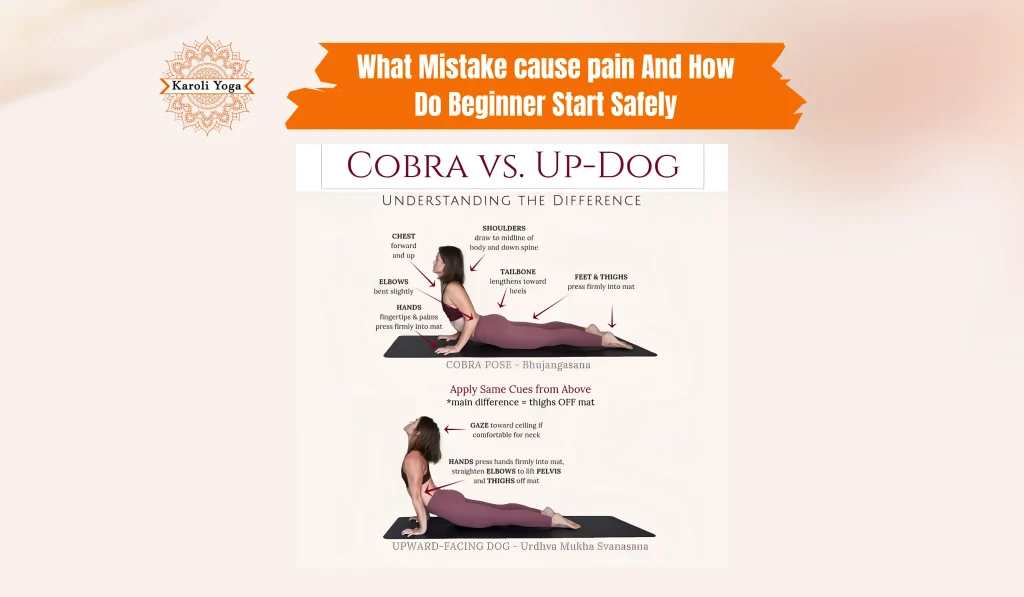
Pain in a backbend nearly always means poor joint line-up or weak muscle effort. Spot these faults early, and your spine stays healthy for years. Each fault breaks the Biomechanics of Cobra Pose and Upward-Facing Dog in a small way.
- Pushing With Arms in Cobra: Straightening the arms too soon jams the lower back before the upper spine warms up.
- Sinking Into the Shoulders: In Upward-Facing Dog, a sinking chest squeezes the neck and overloads the shoulder tendons.
- Beginner Starting Point: If you are new, start with Baby Cobra Pose. It builds gentle back strength before you try full backbends.
Conclusion
Learning the Biomechanics of Cobra Pose and Upward-Facing Dog changes how every backbend feels. You stop forcing deep shapes. You learn to balance leverage, muscle effort, and steady breath. At Karoli Yoga School in Tapovan, Rishikesh, our Indian teachers explain alignment and anatomy step by step.
At Karoli Yoga School in Tapovan, our courses include biomechanics, alignment, and adjustment classes, along with anatomy and injury prevention. You can begin with a 100 Hour Yoga Teacher Training Course in Rishikesh, grow in a 200 Hour Yoga Teacher Training in Rishikesh, or go deeper with a 300 Hour Yoga Teacher Training in Rishikesh. Prefer a short stay? Join one of our Rishikesh Yoga Retreats.
Have questions about the Biomechanics of Cobra Pose and Upward-Facing Dog, our courses, or upcoming dates? Message us on WhatsApp. Our team is happy to help.
You can also follow us on Instagram and Facebook for more yoga tips.
Frequently Asked Questions About Cobra Pose and Upward-Facing Dog
1. What happens if you do a Cobra and Upward-Facing Dog Pose every day?
Daily Cobra Pose strengthens the back muscles, frees the upper spine, and undoes desk slouching. Knowing the Biomechanics of Cobra Pose and Upward-Facing Dog helps your daily practice build strength without pinching your waist.
2. Who should not do Cobra Pose?
Skip full Cobra if you have a recent disc injury, sharp wrist pain, carpal tunnel, or late pregnancy. Ask a doctor or a trained teacher before deep backbends after surgery. The Biomechanics of Cobra Pose and Upward-Facing Dog also help you spot when a backbend is unsafe.
3. How does the Cobra Pose (Bhujangasana) benefit the heart?
Cobra stretches tight chest muscles, widens the rib cage, and improves blood flow around the chest. The Biomechanics of Cobra Pose and Upward-Facing Dog show how a lifted breastbone gives the lungs and heart more room.
4. What are the benefits of upward-facing dog?
Upward-Facing Dog builds the triceps, shoulders, and wrists. It also stretches the belly and hip flexors deeply. Applying the Biomechanics of Cobra Pose and Upward-Facing Dog energizes your spine and eases upper-body stiffness.
5. How to do upward-facing dog?
Lie face down. Place your palms beside your lower ribs. Press through your hands and feet to lift your chest and thighs off the floor. Keep your arms straight, your shoulders away from your ears, and your legs active.